
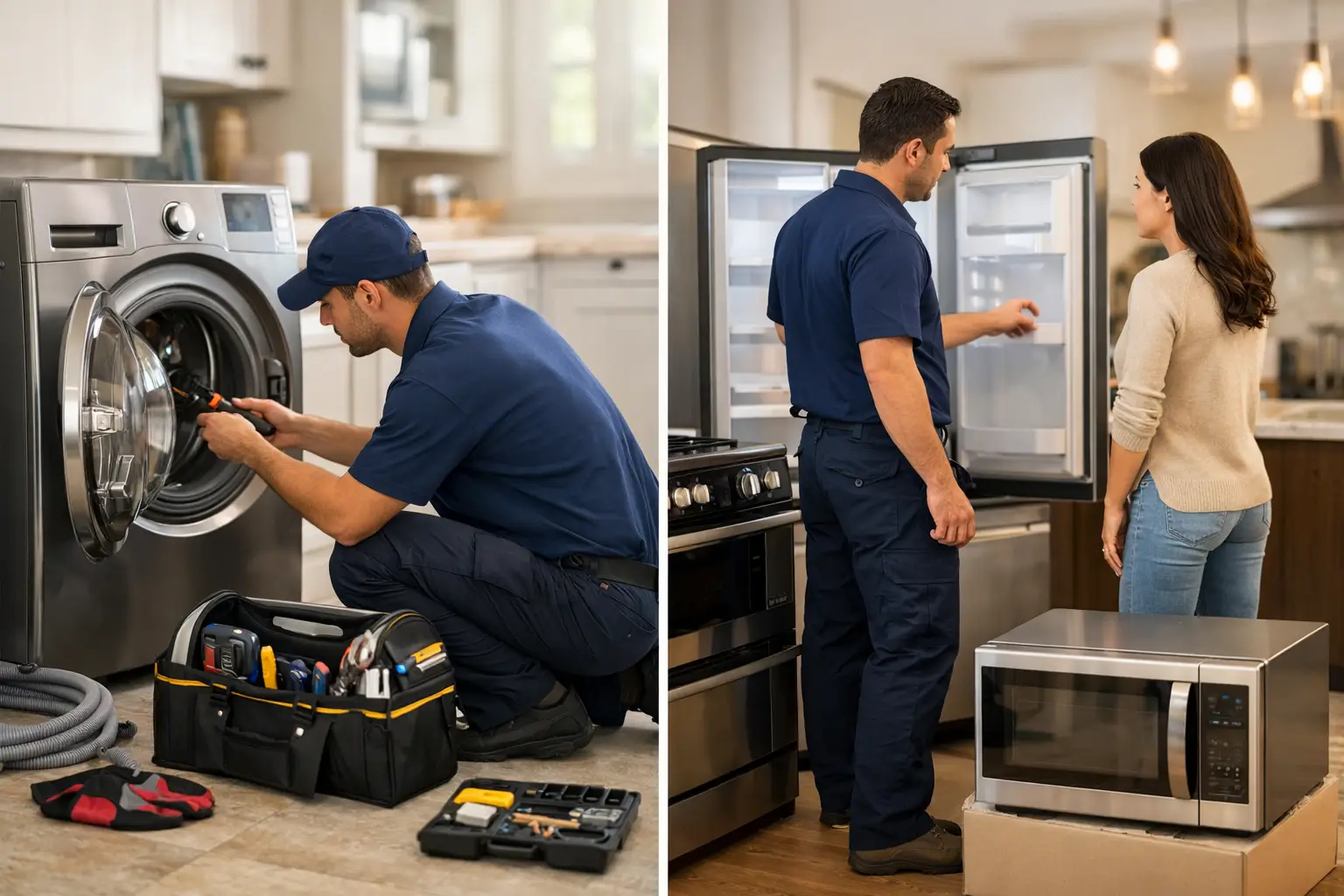
Your refrigerator stops cooling the night before a big grocery run, or your dryer suddenly needs two cycles to finish one load. In moments like that, appliance repair versus replacement stops being a theoretical question and becomes a real household decision with time, money, and stress attached to it.
Most people do not need a complicated formula. They need a clear way to decide whether a fix makes sense or whether it is smarter to move on. The right answer depends on the appliance’s age, the type of problem, how often it has broken down, and whether the issue affects safety or daily life.
How to think about appliance repair versus replacement
A good decision starts with one practical question: is this a one-time problem, or is the appliance starting to become unreliable? If a dishwasher has worked well for years and suddenly needs a new pump or latch, repair is often the reasonable move. If that same dishwasher has already had multiple service visits and is now leaving water at the bottom after every cycle, replacement may be the better long-term choice.
Reliability matters as much as the repair itself. A working appliance is not always a dependable appliance. If you are constantly wondering whether the refrigerator will hold temperature or whether the washer will finish a cycle without stopping, the inconvenience adds up fast.
There is also the issue of urgency. A broken ice maker is annoying. A refrigerator that is warming up is a much bigger problem. A cracked cooktop, a gas smell near an oven, or a dryer that seems unusually hot can move the decision out of the budget category and into the safety category.
When repair usually makes sense
Repair is often the better choice when the appliance is relatively young, the issue is isolated, and the rest of the unit is still in good shape. That is especially true for midrange and higher-end appliances that were built to last and have not shown signs of broader wear.
A few examples are common. A washing machine that will not drain might have a clogged pump or a failed drain component. A dryer that tumbles but does not heat may need a heating-related part rather than full replacement. A refrigerator with a bad door seal or a failing fan motor can often be restored without replacing the entire unit.
Repair also makes sense when the appliance fits your space perfectly and replacing it would create extra hassle. Built-in units, matching kitchen sets, stacked laundry setups, and appliances installed in tight cabinets often involve more than simply swapping one machine for another. In those cases, a solid repair can save time and avoid additional installation headaches.
For busy households and property managers, repair can also be the fastest path back to normal. When the issue can be diagnosed quickly and the fix is straightforward, a professional repair may solve the problem without forcing you into a rushed shopping decision.
When replacement is the smarter call
Sometimes replacement is not wasteful. It is practical.
If an appliance is near the end of its expected lifespan and has started to fail more often, another repair may only buy a little more time. That can make sense for a small issue, but not when the machine is becoming a pattern of disruption. The trouble with repeated breakdowns is not just the repair itself. It is the missed laundry loads, spoiled groceries, dirty dishes in the sink, and constant uncertainty.
Replacement is also worth serious consideration when parts are no longer available, when the repair is extensive, or when the appliance has signs of broader wear. Rust, repeated leaks, electrical issues, poor temperature control, and major motor or compressor problems can all point to a machine that is simply aging out.
Efficiency can matter too, but it should not be exaggerated. A new appliance may use less energy and water, but efficiency alone is not always enough reason to replace a functioning unit. It becomes more relevant when the older appliance is already underperforming, running longer than it should, or costing you through repeated service needs.
Age matters, but it is not the only factor
People often ask for a simple age cutoff, but there is no perfect universal rule. Some appliances last well beyond expectations with proper maintenance. Others have hard lives in busy homes and wear out sooner.
What matters more than age alone is age plus condition. A seven-year-old dryer with one failed part is different from a seven-year-old dryer that overheats, squeals, and leaves clothes damp. A ten-year-old refrigerator that has been dependable and clean inside the mechanical compartment may still be worth fixing. A ten-year-old refrigerator with poor cooling, heavy frost buildup, and recurring service calls is a different story.
Usage matters as well. A washer in a large household may do the work of two machines. A breakroom refrigerator in a small business may be opened constantly. Heavy use shortens life expectancy, so the calendar does not tell the whole story.
Safety should override convenience
Not every appliance issue should be treated as a cost comparison.
If you notice burning smells, exposed wiring, smoke, repeated tripped breakers, gas odor, or visible damage to critical components, stop using the appliance and have it evaluated right away. In these cases, the question is not just whether repair or replacement is cheaper. The first question is whether the unit is safe to keep in service at all.
This is where a professional diagnosis matters. Some problems look dramatic but are repairable. Others seem minor but point to deeper risk. A trusted technician can help separate what is inconvenient from what is unsafe.
The hidden cost of waiting too long
One of the most expensive choices is often delay.
Homeowners sometimes keep restarting a failing appliance, hoping it will hold out a little longer. That can work for a day or two, but it can also make the final outcome worse. A refrigerator that is struggling to cool can put food at risk. A leaking dishwasher can affect flooring and cabinets. A dryer with airflow problems can create bigger performance and safety issues over time.
Even when replacement ends up being the right move, getting a professional diagnosis early helps you make that decision with more confidence. It also gives you a chance to plan instead of reacting during an emergency.
A simple way to make the decision
If you are stuck, think through the appliance in four layers: condition, consistency, safety, and disruption.
Condition means the overall state of the machine, not just the current part that failed. Consistency means whether it has been dependable or whether problems have been stacking up. Safety means any sign that continued use could put your home or family at risk. Disruption means how badly the breakdown affects your routine and whether a quick repair will realistically solve that problem.
When the appliance is in otherwise good condition, has been reliable, and the issue is isolated, repair is usually a strong choice. When the unit is aging, becoming inconsistent, or raising safety concerns, replacement usually makes more sense.
Why a professional opinion helps
A real diagnosis saves guesswork. It tells you whether the issue is minor, whether there are signs of larger wear, and whether the appliance is worth putting more life into. That is especially helpful when you are dealing with essential equipment like refrigerators, ovens, washers, dryers, and dishwashers that your household depends on every day.
For many customers, the best service experience is not just getting a machine fixed. It is getting an honest recommendation. A company that handles repairs every day should be able to tell you when a repair is worthwhile and when replacement is the better use of your time.
That is the kind of practical support people want from a local service partner. If you are in a busy household in places like Orlando, Tampa, Jacksonville, Charleston, or Columbia, speed matters. So does having someone show up, diagnose the issue clearly, and explain the next step without pressure.
CASPI Home Service approaches these calls the same way homeowners do – solve the problem quickly, be upfront about the options, and stand behind the work.
A broken appliance can throw off your whole day, but the decision does not have to feel overwhelming. The best next step is usually the simplest one: get a professional diagnosis, weigh the real condition of the appliance, and choose the option that gives you the most confidence going forward.