


If you live in an apartment, a condo, or a home where cutting a hole through an exterior wall is not an option, you have probably wondered whether a dryer can work without a vent. That is exactly where ventless dryers shine.
A ventless dryer is designed to dry clothes without sending hot, humid air outdoors through ductwork. Instead, it removes moisture inside the machine and either collects that water in a tank or drains it away. The result is flexible installation, cleaner looking laundry spaces, and fewer vent related headaches, though there are tradeoffs like longer dry times on many models.
In this guide, you will learn how ventless dryers work, the two main types, what they cost to run, how to install and maintain them, and how to avoid common problems.
What Is a Ventless Dryer?
A ventless dryer is a clothes dryer that does not require an external exhaust duct. Traditional vented dryers pull in air, heat it, tumble your clothes, then push the warm moisture filled air through a vent to the outside. Ventless dryers still heat and tumble, but they handle moisture differently by condensing water out of the air or by using a heat pump system that recycles heat while removing moisture.
Ventless does not mean “no airflow” or “no heat.” It means the dryer is built to manage moisture internally rather than relying on a duct to carry it outside.
Types of Ventless Dryers
Most ventless dryers fall into two categories: condenser (also called condensing) dryers and heat pump dryers.
1) Condenser ventless dryers
A condenser dryer uses a heat exchanger to cool the warm humid air, turning moisture into water. That water is collected in a removable tank you empty, or it is sent to a drain if the unit is connected to one.
What this means in real life:
- You do not need an exterior vent.
- You do need to remember to empty the water tank unless you plumb a drain line.
- Drying times are often longer than vented dryers, but many people find them acceptable for small to medium laundry routines.
2) Heat pump ventless dryers
A heat pump dryer is also ventless, but it is built for efficiency. It uses a heat pump system to reuse heat rather than constantly creating and exhausting hot air. ENERGY STAR notes that heat pump dryers do not require ventilation and can reduce energy use by at least 28 percent compared to standard dryers.
What this means in real life:
- Lower electricity use for many households.
- Lower drying temperatures that can be gentler on clothes.
- Drying cycles can be longer, especially on large loads, because heat pump drying is designed around steady, lower temperature operation.
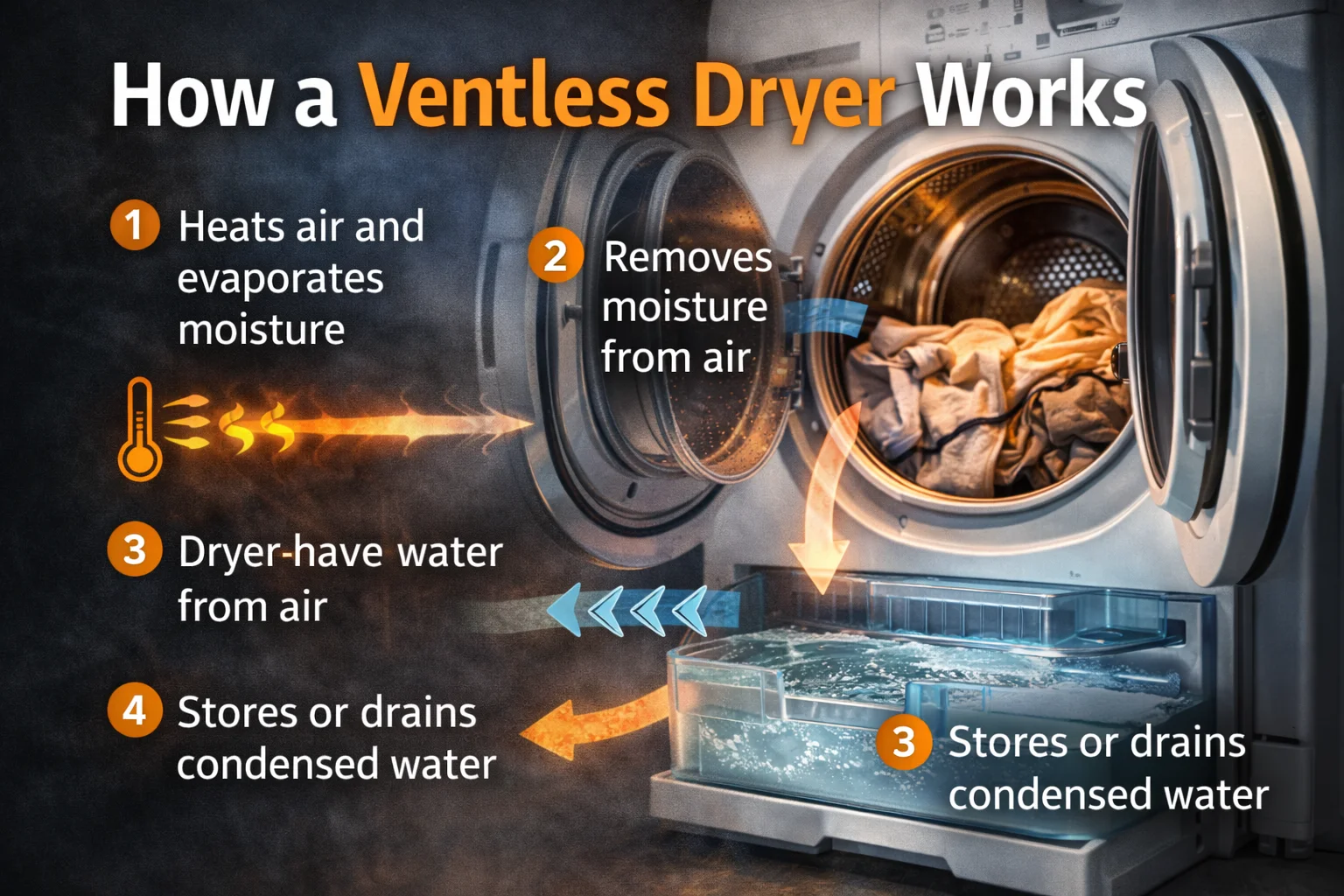
How a Ventless Dryer Works
Here is the simplest way to picture it.
- The dryer warms air and tumbles clothes, so moisture evaporates from fabric.
- Instead of pushing that humid air outside, the machine runs it through a system that removes water from the air.
- The dryer either stores that water in a tank or drains it.
- The air is reheated or recycled and sent back through the drum until the load reaches the target dryness.
Condenser models mainly rely on cooling the air to condense water. Heat pump models do more heat recycling, which is why they often use less energy.
Ventless vs Vented: What Is Different?
A vented dryer is often faster and simpler, but it requires ducting to the outdoors. Many building and fire codes require standard dryer exhaust to discharge outdoors, which is one reason ventless dryers are a popular solution in buildings where venting is impractical.
Ventless dryers avoid the duct entirely, which can reduce lint buildup problems in vents and simplify installation. However, ventless units still produce lint inside the machine, so maintenance is still important.
Pros and Cons of Ventless Dryers
Advantages
Flexible installation
Ventless dryers are often chosen for apartments, interior laundry closets, basements, and remodels because you do not need to route an exhaust duct to an exterior wall.
Energy efficiency, especially heat pump
Heat pump dryers can use significantly less energy than standard electric dryers.
Gentler drying
Lower drying temperatures can be better for delicates and can reduce wear on fabrics over time.
Tradeoffs
Longer drying times
Many ventless models, especially heat pump types, can take longer per load than a typical vented dryer. Some retailers note heat pump ventless models may run in the 90 to 150 minute range depending on load and settings.
More maintenance steps
If your model uses a water tank, you will empty it regularly. You may also have extra filters or condenser areas to clean.
Upfront cost
Heat pump dryers often cost more than basic vented models, though operating savings may offset some of that over time.
Where Ventless Dryers Make the Most Sense
Ventless dryers are usually the best fit if one or more of these are true:
- You cannot vent outside due to building design, HOA rules, or rental restrictions.
- Your laundry area is in the middle of the home, far from an exterior wall.
- You want an efficient electric option and are okay with longer cycles.
- You are pairing a compact dryer with a compact washer for a small space.
They are also common in combo units, especially in tight spaces where people say they “took up washer and dryer” into one machine to simplify installation.
Installation Requirements
Ventless does not mean “install anywhere with no planning.” Here is what still matters.
Power
Most ventless dryers are electric and require the correct outlet and circuit. Always check the manufacturer specs for voltage and amperage.
Drain option (recommended)
Many condenser and heat pump dryers let you connect a drain hose so you do not have to empty the water tank. If you have a floor drain, standpipe, or sink drain nearby, this is a major convenience.
Room ventilation and heat
Because ventless units do not exhaust outdoors, they can add a little heat to the laundry area. In most homes it is manageable, but in very tight closets you will want some airflow around the unit per the manual.
Maintenance Checklist for Better Performance
Ventless dryers run best when airflow is clean and heat exchange surfaces can do their job.
- Clean the lint filter every load, same as any dryer.
- Empty the water tank if you are not connected to a drain.
- Clean secondary filters and condenser areas as instructed by your model.
- Do not overload. Overloading increases cycle time and can lead to damp spots.
- Use high spin speed on the washer. Less water in clothes means much faster drying.
- This is also where many “my dryer is slow” complaints come from, even when nothing is broken.
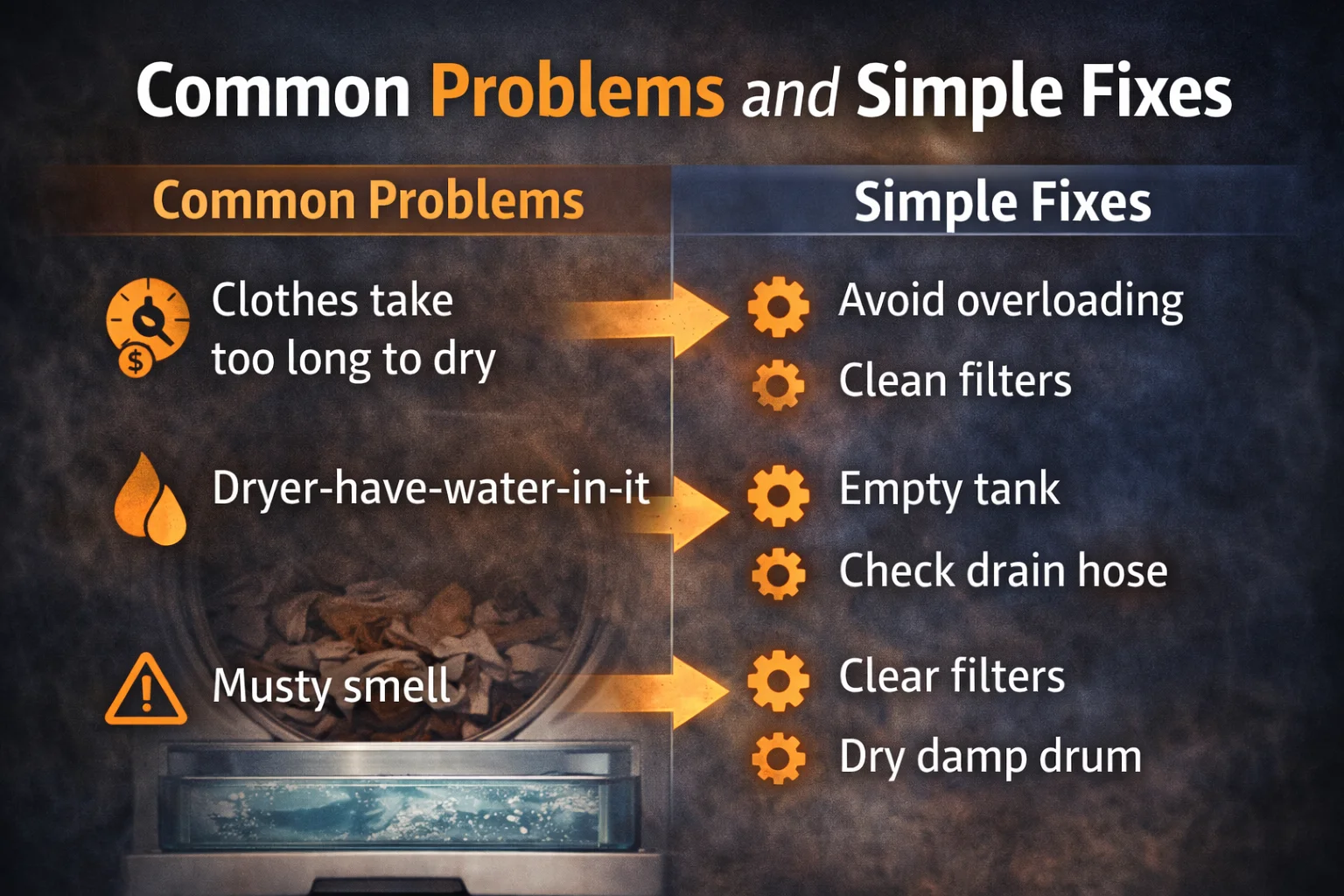
Common Problems and Simple Fixes
Clothes take too long to dry
This is often caused by overloading, low spin extraction, dirty filters, or selecting a lower heat setting. Heat pump dryers in particular may take longer by design.
The dryer has water inside
If you notice dryer have water in it, the most common causes are a full tank, a kinked drain hose, or a drain connection that is higher than the unit can pump. Check the tank, then inspect the hose routing. If the unit is plumbed, confirm the drain is open and not clogged.
Musty smell
This can happen if lint and moisture build up in filters or if loads sit too long after finishing. Clean filters, run a short warm cycle with no clothes to dry the drum, and keep the door slightly open between uses if your space allows.
Error codes
Many modern dryers will alert you when the tank is full, airflow is restricted, or a filter needs cleaning. Treat these as performance warnings first, then investigate further.
When to Call for Help
If your dryer stops heating, trips breakers, or repeatedly shows errors after cleaning and resetting, it is time to bring in a professional. One well timed appointment with a dryer repair service can prevent repeat breakdowns and reduce the risk of damaging sensitive components.
Also consider professional help if you hear unusual grinding, if the drum does not turn, or if drying performance suddenly drops even after you cleaned filters and checked drainage.
Ventless Dryer Costs and Efficiency
Operating costs depend on electricity rates, load size, and cycle length. Heat pump dryers are commonly promoted for lower energy use, including ENERGY STAR’s point that they can reduce energy use by at least 28 percent compared to standard dryers.
If your priority is the lowest monthly cost and you can handle longer cycles, heat pump is usually the efficiency leader. If your priority is faster cycles with ventless flexibility, a condenser dryer may be a better balance.
Ventless Dryers and Indoor Air Questions
A ventless dryer is not the same as venting a traditional dryer indoors. Indoor vent kits for vented dryers can push moisture and fine lint particles into the home and may be against code in many places, which is why ventless dryers are often considered a better alternative when exterior venting is not possible.
Ventless dryers are designed to manage moisture internally, but you still want to keep up with lint filtration and cleaning so the machine can condense and capture moisture properly.
Buying Tips: How to Choose the Right Ventless Dryer
- Choose heat pump if you want maximum efficiency and gentler drying.
- Choose condenser if you want ventless installation with potentially faster drying than some heat pump cycles.
- Check capacity carefully. Many ventless models are compact, which is ideal for small spaces but may require more loads for large households.
- Plan your drain approach. If you can plumb a drain hose, your day to day routine will be easier.
Final Takeaway
So, what is a ventless dryer? It is a dryer that removes moisture without an external exhaust duct, using either a condenser system or a heat pump system. Ventless dryers are a smart solution for spaces where venting is difficult, and heat pump models can be especially efficient.
If you choose the right type for your home and keep up with filters and drainage, a ventless dryer can deliver reliable results with a cleaner install and fewer vent related complications.
FAQ
Do ventless dryers work as well as vented dryers?
Yes, but many ventless models take longer, and performance depends heavily on filter cleaning, load size, and washer spin speed.
Do I need a special room for a ventless dryer?
No, but you should follow clearance requirements and keep the area reasonably ventilated according to the manual. Ventless dryers are popular specifically because they offer installation flexibility.
What does it mean when my dryer “went clean out”?
If your display or routine makes it feel like the dryer went clean out cycle or prompt keeps appearing, it usually points to filter maintenance, airflow restriction, or a sensor reading that wants you to clean lint and condenser areas. Clean all filters thoroughly, empty the tank, and rerun a test load.