
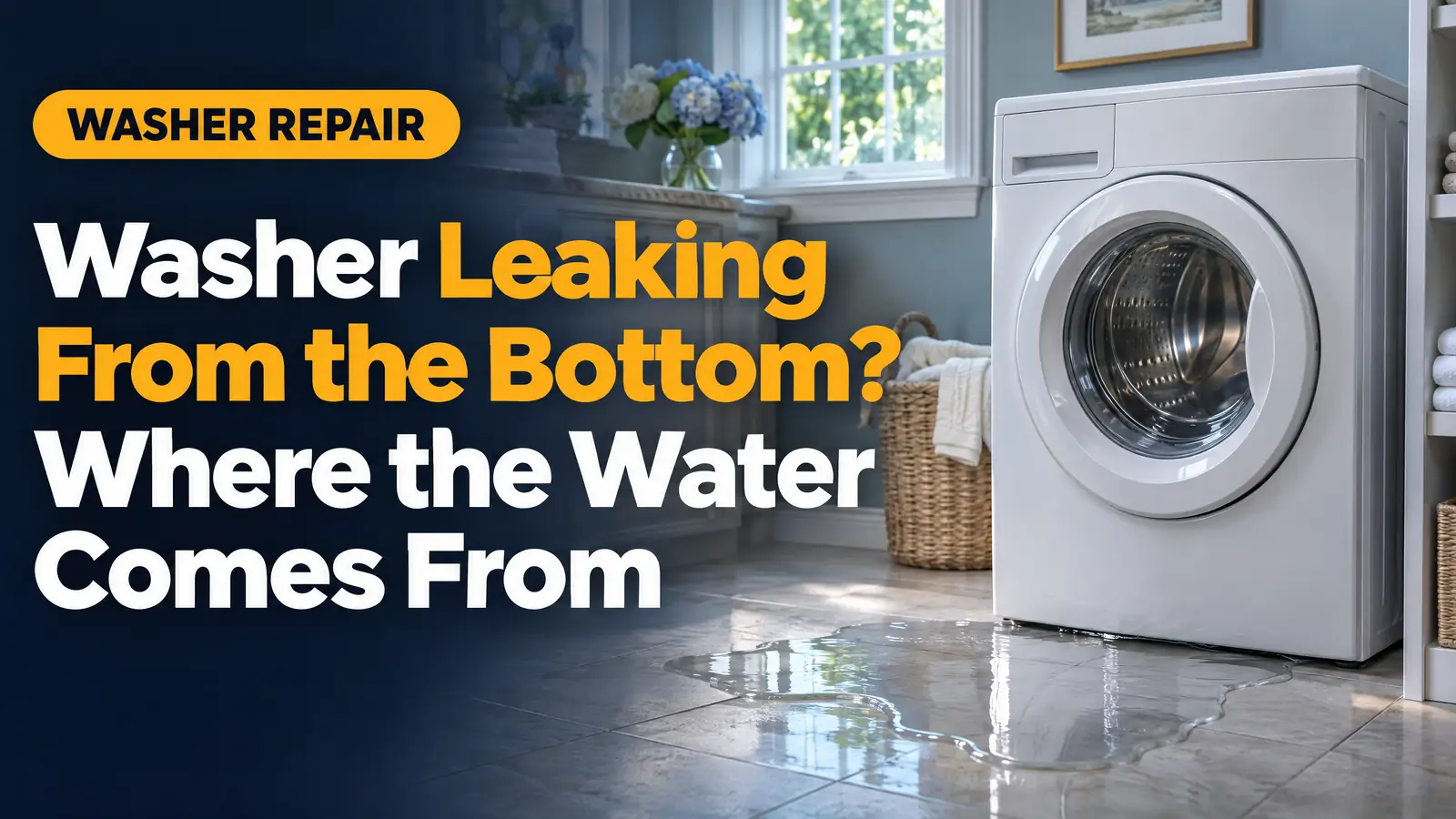
A washer leaking from the bottom is most often losing water at one of four places: a supply hose or its rubber washer at the back, the drain hose or drain pump filter, the door seal on a front-loader, or suds pushed out by too much detergent. Most of those are free or cheap to fix. This guide shows how to find the source by when the water shows up, what to check yourself, and what needs a technician.
Quick answer
- Leaks while filling point to the supply hoses or inlet valve. Leaks while draining point to the drain hose, pump filter or pump.
- A puddle with the washer off and nothing running usually means a supply hose or an inlet valve that no longer closes.
- On a front-loader, a few drips after you open the door are normal. A leak with the door shut is not.
- Too much detergent, or detergent that isn’t HE, can push suds and water out the bottom.
- Water from under the middle of the machine during the wash, with hoses dry, is usually an internal part: book a technician.
Safety first
- Unplug the washer before you touch anything around it. Water and a 120-volt outlet behind the machine don’t mix.
- Turn off both water valves on the wall behind the washer before you check or tighten a hose.
- Mop up the water first so you don’t slip, and so you can see where new water appears.
- Drain a full washer before you pull it out, and get a second person: dragging it can tear a hose.
Where is the water coming from? Use the timing
The fastest way to find a washer leak is to watch when the puddle grows. Dry the floor, put down a dry towel or sheets of paper towel, and run a short cycle while you stay in the room. Water that appears while the tub fills points to the supply side; water during drain or spin points to the drain side.
| When it leaks | Most likely source | What to check first | When to call |
|---|---|---|---|
| While filling | Supply hose, hose washer, inlet valve | Hose ends at the wall and the washer, the rubber washers inside them | Water drips from the valve body on the washer |
| While draining or spinning | Drain hose, standpipe, pump filter, drain pump | Hose depth in the standpipe, kinks, the pump filter cap | Water comes from the pump area with the filter tight |
| From the front, door shut | Door seal (front-loader), detergent drawer | Hair, socks or tears in the seal fold; detergent amount | The seal is torn or split |
| When it’s not in use | Supply hose, inlet valve leaking through | Hoses and connections; is water slowly filling the tub? | Water enters the tub with the washer off |
| During the wash, hoses dry | Internal hose, tub seal, cracked outer tub, oil leak on some top-loaders | Look for oily residue in the water | Right away: these are technician repairs |
Check these first (no tools)
- Unplug the washer and shut both water valves. Then dry the floor so you start clean.
- Make sure it really is the washer. Look up. A dripping pipe, water heater or air conditioner drain line can leave a puddle under it too.
- Front-loader? Open the door and look at the bottom of the seal. Samsung says even a single strand of hair or a piece of thread caught in the door seal can cause a leak. Clear it out and wipe the seal.
- Check the detergent. Use HE detergent in an HE washer, and less of it than the cap suggests if you see suds. Samsung’s guide says excess or non-HE detergent leaves residue that contributes to leaks, and recommends an empty cycle with no detergent to see whether suds still appear.
- Don’t overload it. A packed drum pushes water against the door and seal.
- Check that the washer is level. One that rocks can slosh water out and wear the door seal unevenly. Adjust the legs until it sits firmly on all four.
Why is my washer leaking from the bottom? The causes, most likely first
1. A supply hose or its rubber washer
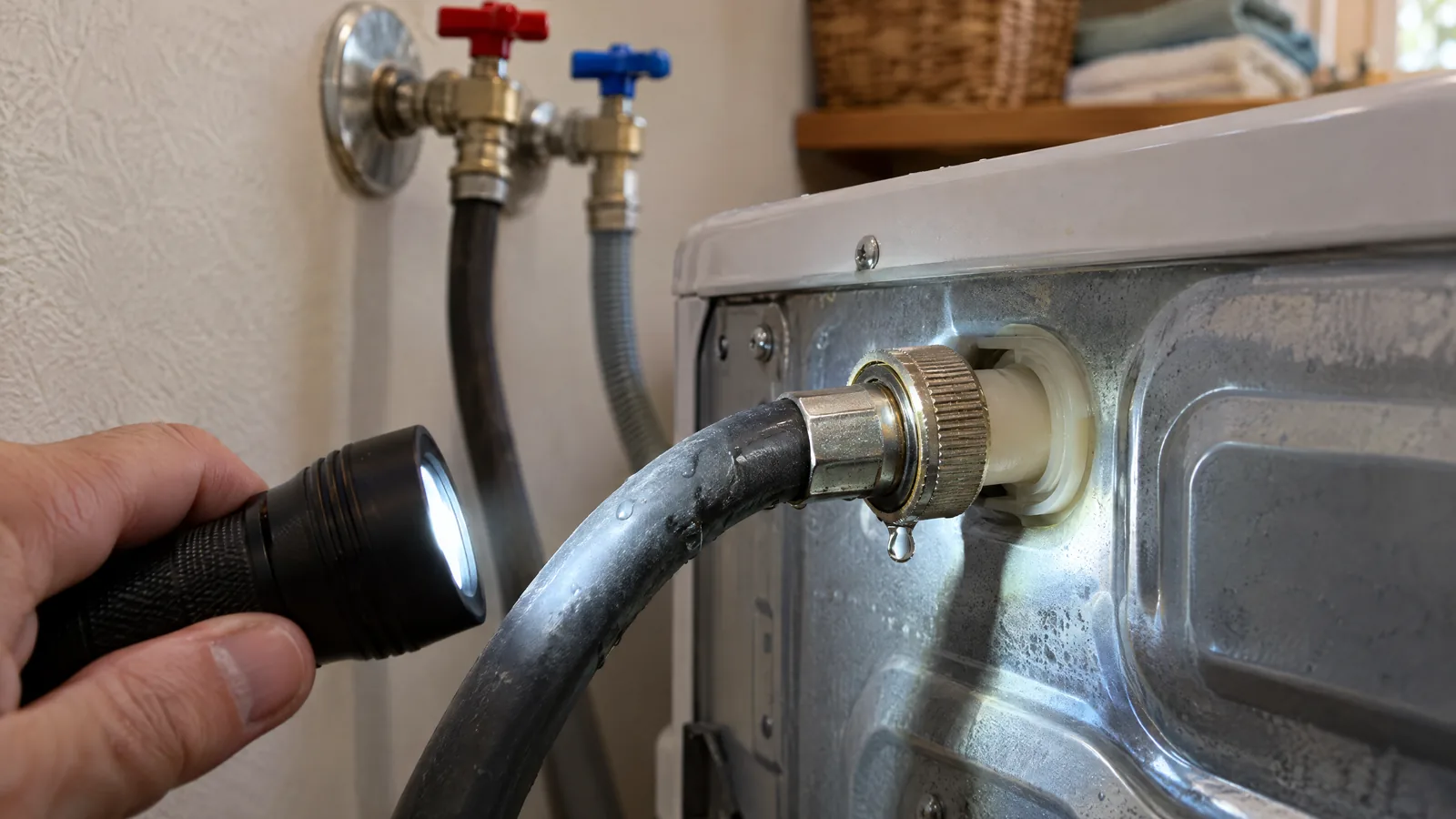
The two fill hoses carry full house water pressure whenever the valves are open, so this leak does the most damage. Hoses crack or bulge with age, and the rubber washer inside each end can split, harden or go missing after the machine is moved.
How to tell: water runs down the back of the washer and spreads out from under it, mostly while it fills. With the water on, run a dry paper towel around each hose end. Fix: with the water off, unscrew the hose, check the rubber washer is there and flat, and thread it back on straight, hand-tight plus a little more. Don’t overtighten plastic fittings. A cracked, bulging or old hose gets replaced. Whirlpool’s guidance is plain: fill hoses should be replaced every five years. If the hoses are fine but the wall valve itself drips, that’s plumbing, not the washer.
2. The drain hose and how it sits in the standpipe
A drain hose at the wrong depth or height can siphon or spill out of the standpipe behind the washer, which looks exactly like a leak from under the machine.
Samsung’s installation numbers are a useful check for most washers: the hose goes 6 to 8 inches into the drain pipe, held with a zip tie so it can’t slide deeper, and the top of the hose loop sits at least 18 inches and no more than 96 inches high. The fit should not be airtight: an airtight seal causes siphoning. How to tell: water around the standpipe or running down the wall during drain. If the standpipe itself overflows, the house drain is slow and a plumber is the right call. Fix: reset the hose depth, straighten any kink or pinch behind the washer, and replace a cracked hose. Samsung also warns not to remove the screw that holds the drain hose to the back of the washer.
3. The drain pump filter (front-loaders)
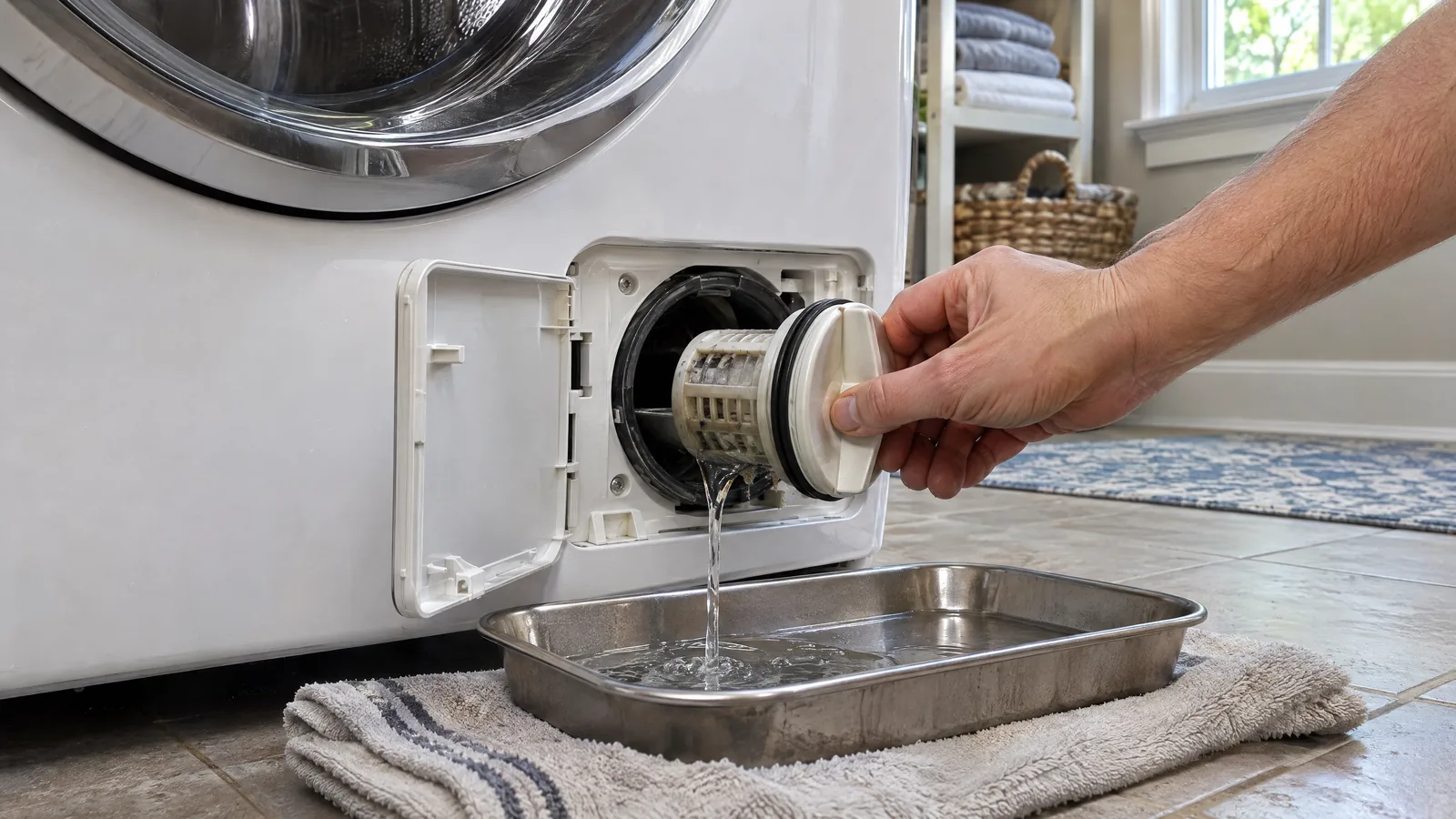
Most front-loaders have a small door at the bottom front with a round filter cap behind it. A cap that wasn’t screwed back tight after cleaning, or a filter packed with lint and coins, can drip during the drain.
How to tell: water appears at the front bottom corner during drain or spin. Fix: unplug the washer, put a towel and a shallow pan under the access door, drain the water through the small hose if there is one, then unscrew the cap, clean it and screw it back in fully. Samsung recommends cleaning the pump filter at least once a month, or every 40 washes, and says a neglected filter can cause draining problems and even leaks. If a Samsung washer also shows a drain code such as 5C or SC, our Samsung washer error codes guide explains what to check next. Top-loaders usually don’t have a filter you can reach.
4. The door seal (front-loaders)
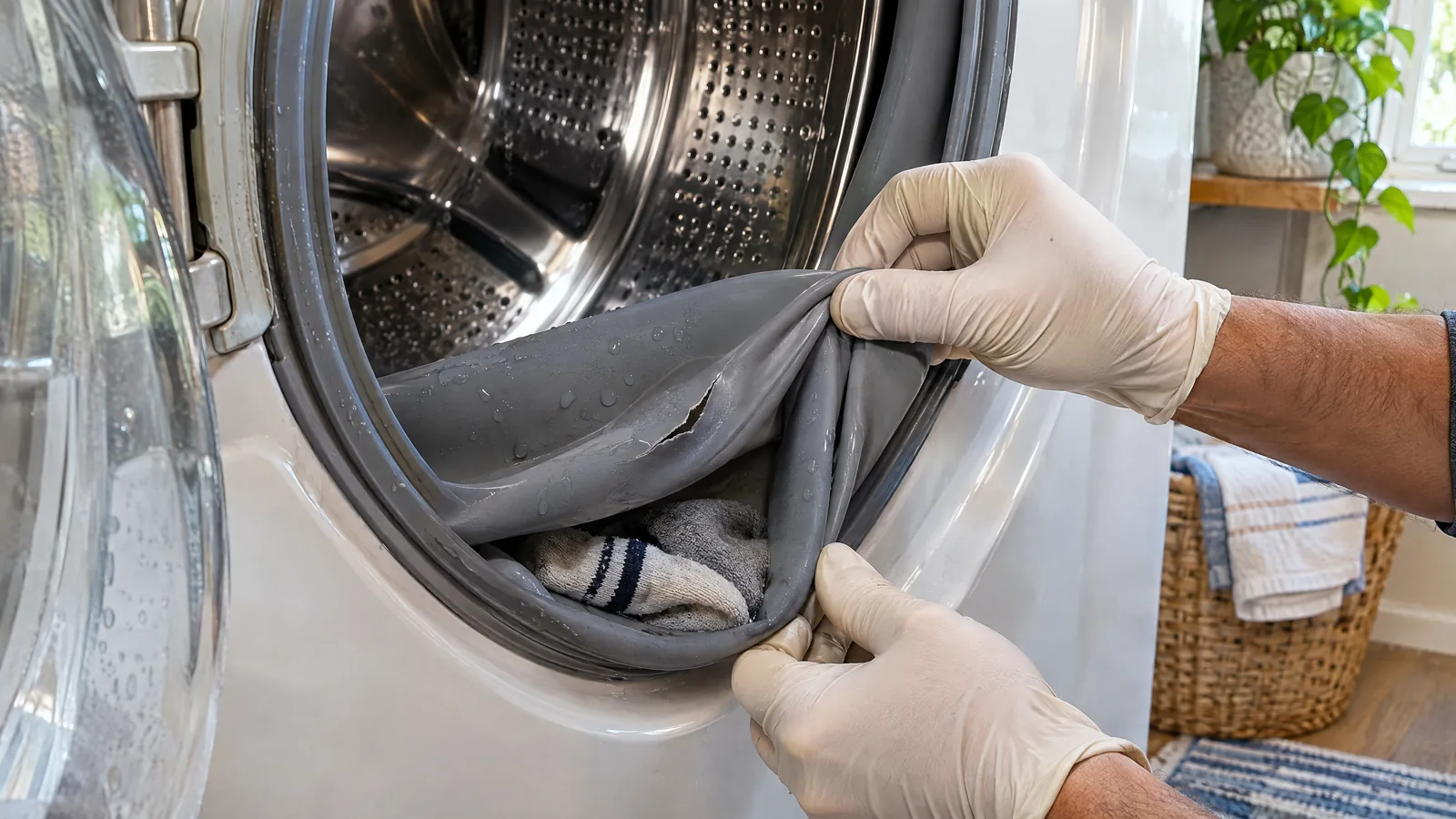
The rubber boot between the door and the tub folds over on itself and catches socks, hair, coins and grit. A pin or underwire can cut it.
How to tell: water runs down the front of the washer with the door closed, often during the wash or spin. Remember Samsung’s note: a few drips after you open the door are normal. Fix: fold the seal back all the way around and remove anything trapped. A torn or split seal has to be replaced, which means removing the front clamp and often the front panel. That’s a technician job.
5. Too many suds or a dirty detergent drawer
Too many suds push water out around the dispenser drawer, and it runs down inside the cabinet to the floor. How to tell: foam in the drum or water near the drawer. Fix: per Samsung, use less detergent, confirm it’s HE, seat any drawer cover and clean soap buildup out of the drawer, then run a test cycle.
6. An inlet valve that won’t close
The water inlet valve on the back of the washer opens to fill and should shut tight. When it fails, it can drip, or let water seep into the tub with the washer off. GE says that if a washer drips water or fills with water when it is not turned on, the water valve may have failed and usually needs to be replaced. How to tell: the tub slowly gets water in it overnight, or the valve body is wet with the hoses dry. A valve is a repair part, so this one goes to a technician or a confident DIYer with the water and power off. Until then, shut the wall valves between loads.
7. Internal parts: pump, internal hoses, tub seal, cracked tub
If the hoses, standpipe, filter and seal all check out, the leak is inside the cabinet. The drain pump housing or its seal can crack, an internal hose or clamp can let go, and on some machines the tub seal or the outer tub itself fails. GE sorts its leak help by whether oil is leaking out as well, because on some top-loaders an oily puddle comes from the drive or transmission area rather than the water plumbing. HomeGuide notes that the outer drum is the watertight container, so a crack there causes leaks. These all mean opening the cabinet: book a technician.
If water still shows up after these checks with the hoses dry, that’s where a technician saves you time: book a washer repair online and get the price before any work starts.
Front-load vs. top-load: where each one usually leaks
A front-loader leaks most often at the door seal, the pump filter or from suds, because water sits against the door. A top-loader has no door seal, so its leaks usually come from the hoses, the drain hose and standpipe, or an internal part such as the pump, a tub seal or the drive area.
What does it cost to fix a leaking washer?
Most washer leak repairs cost $75 to $400, depending on the part. Hoses and valves are at the low end, a front-load door seal or a drain pump costs more, and a cracked tub can cost enough that replacing the washer makes more sense. Prices vary by brand and model.
| Repair | HomeGuide (installed) | Fixr (installed) |
|---|---|---|
| Stop a leak (general) | $100 to $400 average washer repair | $75 to $200 |
| Drain hose | $100 to $200 | $95 to $170 |
| Water inlet valve | $100 to $300 | $95 to $190 |
| Drain pump | $150 to $350 | $300 to $400 |
| Front-load door seal | $275 to $600 | $230 to $300 |
Sources: HomeGuide washing machine repair cost and Fixr washing machine repair cost (updated January 31, 2025). A supply hose you replace yourself costs only the part.
Worked example: fix it or replace it?
- A 5-year-old front-loader leaks from a torn door seal. HomeGuide’s top figure for the seal is $600; its range for a new washer is $700 to $1,300.
- HomeGuide’s rule of thumb: a repair is worth it when the washer is under 7 years old. At 5 years with no other problems, fixing the seal is the better buy.
- The same seal on a 12-year-old washer that also needs bearings: replacing it is usually the better call.
- For more on part prices across all appliances, see our appliance repair cost guide, and for typical service life, how long appliances last.
Florida and South Carolina: humidity, condensation and fast drying
In a humid laundry room, garage or utility closet, cold supply hoses and pipes can sweat. Condensation dripping off a cold hose can look like a leak, so check whether the water appears only when cold water is running and the hose surface is wet all along, not at a fitting. The EPA suggests keeping indoor humidity below 60 percent, ideally 30 to 50 percent, and covering cold water pipes with insulation to prevent condensation.
Speed matters more here too. The EPA says that if wet materials are dried within 24 to 48 hours after a leak, in most cases mold will not grow. A slow leak under a washer can soak a subfloor or baseboard for weeks before anyone sees it, so pull the washer out, dry the area with fans and fix the source the same week.
How to stop it happening again
- Replace the supply hoses every five years, per Whirlpool, and sooner if they bulge or crack.
- Turn the wall valves off before you travel.
- Clean the front-loader pump filter monthly or every 40 washes (Samsung’s interval) and wipe out the door seal after the last load of the day.
- Use HE detergent in the amount the label gives for your load size.
- Keep the drain hose at the right depth and free of kinks.
When to call a technician
Call when the water comes from inside the cabinet, from the drain pump area with the filter tight, from a torn door seal, or from the inlet valve, or when you see oil in the puddle. Caspi Home Service repairs front-load and top-load washers of all major brands, including Samsung, Whirlpool and GE. There’s no service-call fee when you book, the price is given up front before work starts, and the repair comes with a 90-day parts-and-labor warranty.
Frequently asked questions
Why is my washer leaking from the bottom when not in use?
Water under a washer that isn’t running usually comes from the supply side, because that’s the only part under pressure when the machine is off. Check both hose ends and their rubber washers. If the tub slowly fills with water while the washer is off, the inlet valve is leaking through and needs replacing. Turn the wall valves off until it’s fixed.
Why is my washer leaking only when draining?
Check the drain side: the drain hose and its depth in the standpipe and, on a front-loader, the pump filter cap. An overflowing standpipe means a slow house drain and a plumber. Water from the pump area with the filter tight points to the drain pump or its housing.
Why is my front load washer leaking from the bottom of the door?
Usually something is caught in the door seal, the seal is torn, or there are too many suds. Clear the seal fold, use less HE detergent and don’t overload the drum. A few drips right after you open the door are normal; a leak with the door closed is not.
Is it safe to use a washer that is leaking?
Not until you know where the water comes from. Water near the outlet behind the washer is an electrical risk, and a slow leak damages flooring. Unplug it, turn the water off and dry the area, then fix the source and run a test load while you watch.
Washer still leaking?
Book a Caspi Home Service technician. Same-day and next-day appointments are available, with a free estimate when you book online and no service-call fee.