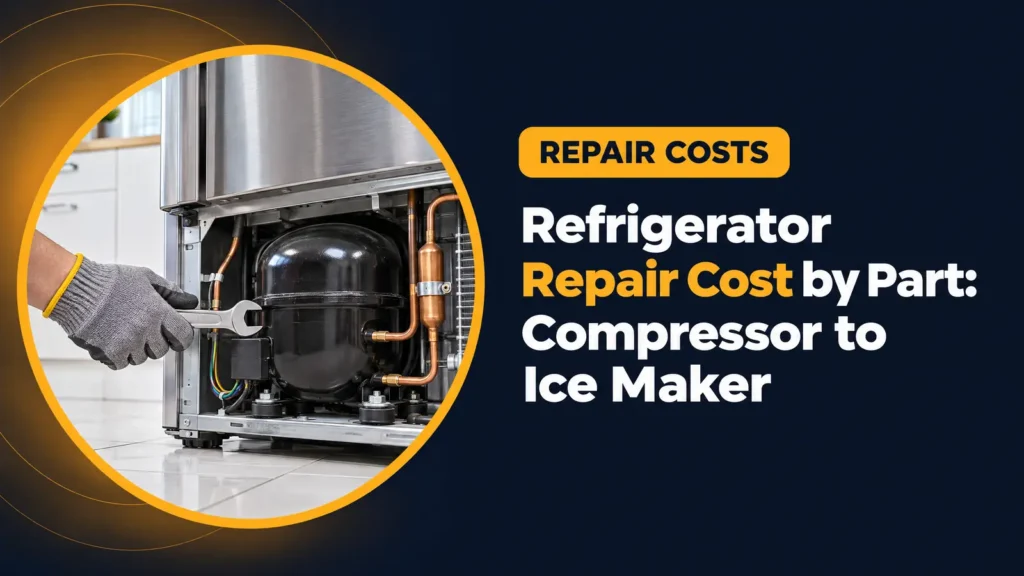
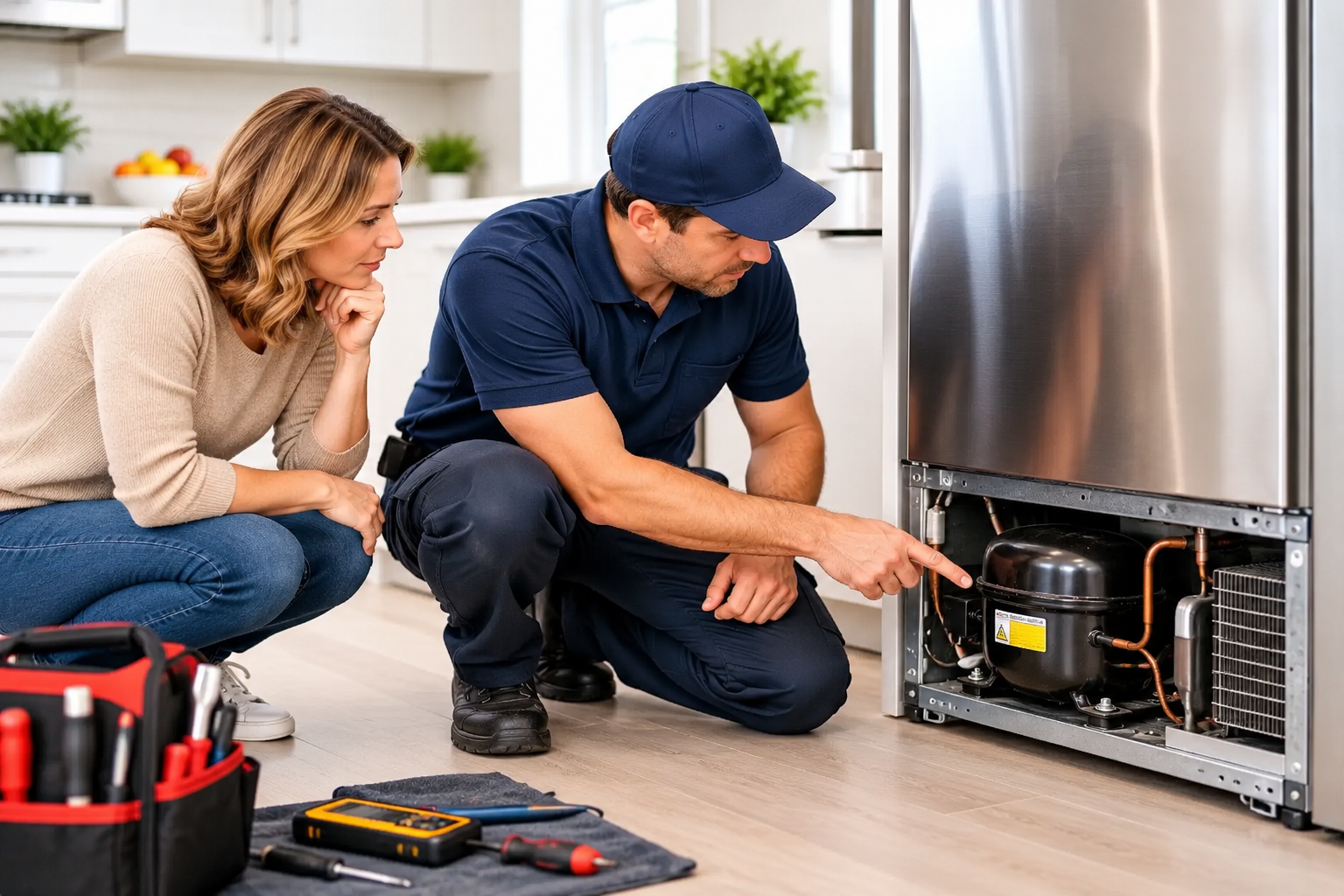
The clearest signs of a failing refrigerator compressor are a fridge and freezer that both warm up while the compressor hums, clicks or won’t start, a compressor that runs nonstop, or one that’s too hot to touch. But dirty condenser coils, a dead fan or a bad start relay cause the same symptoms and cost far less. This guide shows which sounds are normal, how to rule out the cheap causes, and what a compressor repair costs.
Quick answer
- A steady hum and a single click when the compressor starts or stops are normal.
- Warning signs: both compartments warming, clicking every few minutes with no start, nonstop running, a very hot compressor, a tripped breaker.
- Rule out dirty condenser coils, a stopped condenser fan and a blocked freezer vent first.
- A click-then-silence pattern is often the start relay, a much cheaper part than the compressor.
- Compressor replacement is sealed-system work for an EPA-certified technician, and HomeGuide puts it at $700 to $1,250.
What does the compressor do, and why does it fail?
The compressor is the pump at the bottom back of the fridge. It squeezes refrigerant gas and pushes it through the condenser coils, where heat leaves the cabinet, and on to the evaporator, where it pulls heat out of the food compartments. When it stops pumping, both the freezer and the fridge warm up together.
Compressors rarely fail on their own. They wear out faster when they work too hard: coils packed with dust, a condenser fan that quit, a fridge jammed against a wall with no airflow, or repeated power surges. HomeGuide says a compressor lasts 5 to 10 years on average, and up to 20 years for a high-quality part in a fridge that’s serviced regularly.
Normal compressor sounds vs. warning signs
Most fridge noises are normal. Whirlpool’s sound guide says a single click can occur when the compressor starts or stops, and a low, steady hum is common, especially after the doors have been opened. Samsung describes its compressor as sounding like a quiet engine that can change speeds, and says a short, quiet rattle of under 10 seconds as it shuts off is normal.
| What you notice | Usually normal when | A warning sign when |
|---|---|---|
| Humming | Low and steady, then it stops as the fridge reaches temperature | Loud, and the fridge is still warm hours later |
| Clicking | One click as the compressor starts or stops | A click every few minutes, the compressor never runs, the fridge warms up |
| Rattling | A few quiet seconds as it shuts off | Loud knocking or rattling while it runs, on a level fridge |
| Running time | Long runs after loading groceries or on a hot day | It never shuts off and the fridge still isn’t cold |
| Heat at the back | Warm air from the bottom vent | The compressor shell is too hot to touch for a second |
8 signs your refrigerator compressor is failing
1. Both the fridge and the freezer are warming up
A compressor problem affects both compartments, because the freezer’s evaporator is where all the cold is made. If only the fresh-food side is warm and the freezer is fine, the compressor is working: that pattern points to an airflow problem, covered in our guide to a refrigerator not cooling while the freezer works. Check with a thermometer in a glass of water on a middle shelf. The FDA says the fridge should be at 40°F or below, and the freezer at 0°F.

2. Clicking every few minutes, then nothing
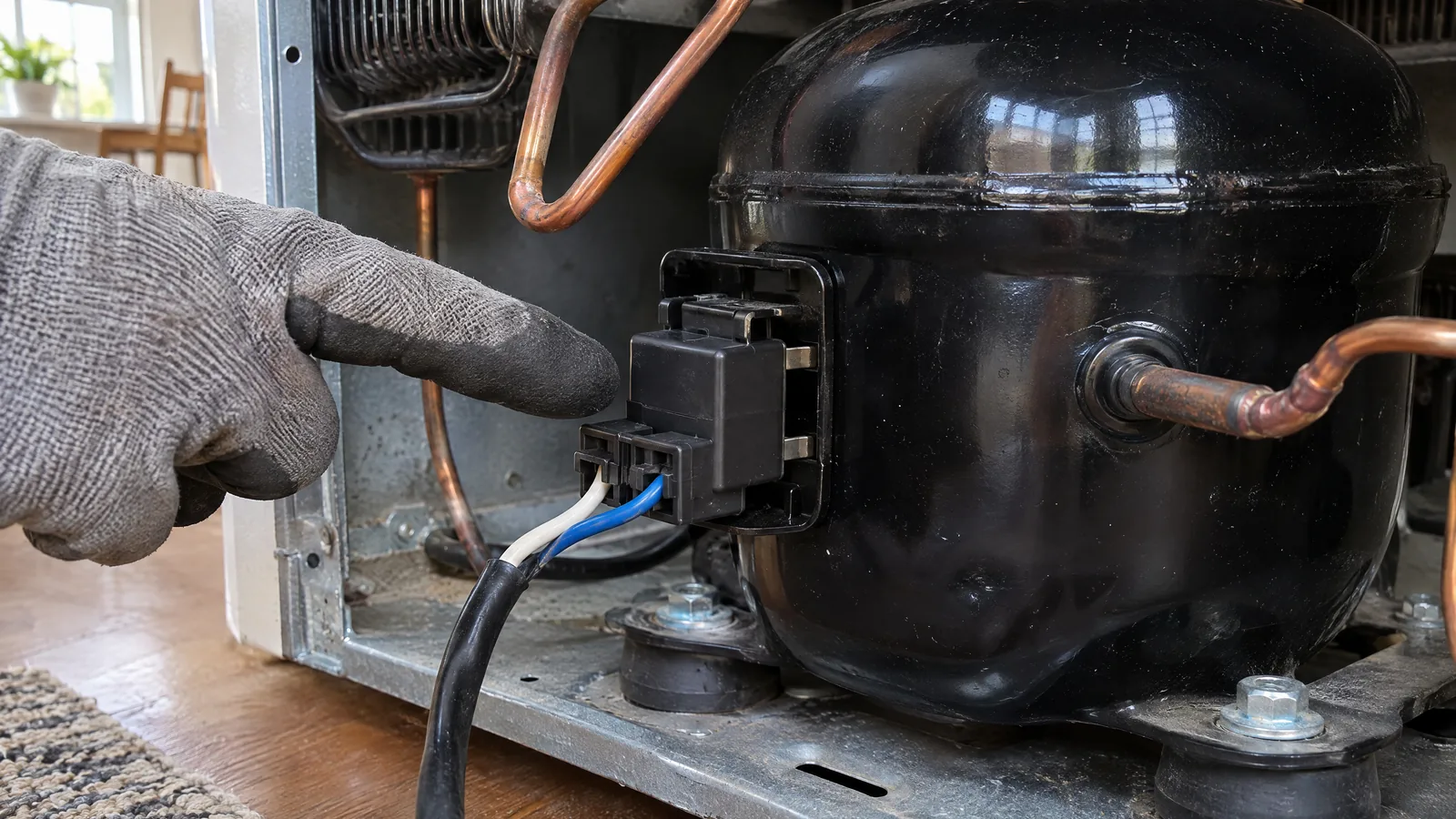
A click, a few seconds of buzzing, another click and silence, repeating every few minutes, is the classic start-up failure. The compressor tries to start, draws too much current, and the overload protector cuts it off. The cause is often the start relay or start capacitor mounted on the side of the compressor, which is a far cheaper repair than the compressor itself. If a new relay doesn’t fix it, the compressor windings may be failing.
3. Loud humming or buzzing with no cooling
A compressor that hums loudly but the fridge stays warm may be stuck mechanically, or running without moving refrigerant. Samsung’s advice for a buzzing or humming compressor is simple: if it’s very loud, it needs service.
4. It runs all the time
Long run times are normal after you load groceries or on a hot day. A compressor that never cycles off while the fridge is still warm is either losing the fight against dirty coils, a bad seal or a failed fan, or it has lost pumping power. The first three are cheaper fixes, so check them before blaming the compressor.
5. It won’t run at all
The lights work but there’s no hum and the fridge warms up. The compressor may be fine: a failed relay, a control board that isn’t sending power, or a defrost timer stuck in defrost will all keep it off. This is diagnosis work with meters and live power, so it’s a technician job.
6. The compressor is too hot to touch
The compressor runs warm, but HomeGuide says it should never feel hot to the touch, and that overheating is a sign it’s working too hard. Unplug the fridge, let it cool, clean the coils and check the condenser fan before you plug it back in.
7. The breaker trips or there’s a burning smell
A compressor with a shorted winding can trip the kitchen breaker each time it tries to start, and HomeGuide lists breaker trips and a foul smell among compressor failure signs. Don’t keep resetting the breaker. Unplug the fridge and book a technician.
8. Your electric bill went up for no reason
A worn compressor, or one fighting dirty coils, runs longer and uses more power. ENERGY STAR estimates that refrigerators over 15 years old could be costing about $95 a year more to run, which matters when you’re deciding between a repair and a new fridge.
Safety first
- Unplug the refrigerator before you remove the back access cover, touch the coils or go near the compressor.
- Never cut, pierce or open the refrigerant tubing. Under EPA rules, anyone who repairs equipment that could release refrigerant must be certified.
- Don’t test a relay, compressor or control board on live power. That’s work for a technician with the right meters.
- If the breaker trips or you smell burning, leave the fridge unplugged until it’s checked.
Is it the compressor? Check these first
Most “bad compressor” calls turn out to be something cheaper. Work through these in order, with the fridge unplugged for anything behind it.
- Check the temperature settings. Make sure nobody bumped the control, and that the fridge isn’t in a showroom or demo mode.
- Give it room to breathe. Pull the fridge out a little from the wall and clear anything stored on top or packed against the bottom grille.
- Clean the condenser coils. Unplug the fridge, remove the bottom grille or rear access cover, and vacuum the coils with a brush attachment. Whirlpool says to vacuum the coils as directed in the use and care guide to help the compressor run efficiently and quietly.
- Listen for the condenser fan. On fridges with coils underneath, a small fan next to the compressor runs when the compressor runs. If the compressor hums and the fan is still, the compressor overheats. A fan motor is a much smaller repair.
- Check the freezer vents and the door seals. A packed freezer can block the vents, and a torn gasket lets warm air in all day. Close a dollar bill in the door: if it slides out with no drag, that section of seal isn’t sealing.
- Look for frost on the freezer’s back wall. Heavy, even frost over the back panel points to a defrost problem, not the compressor.
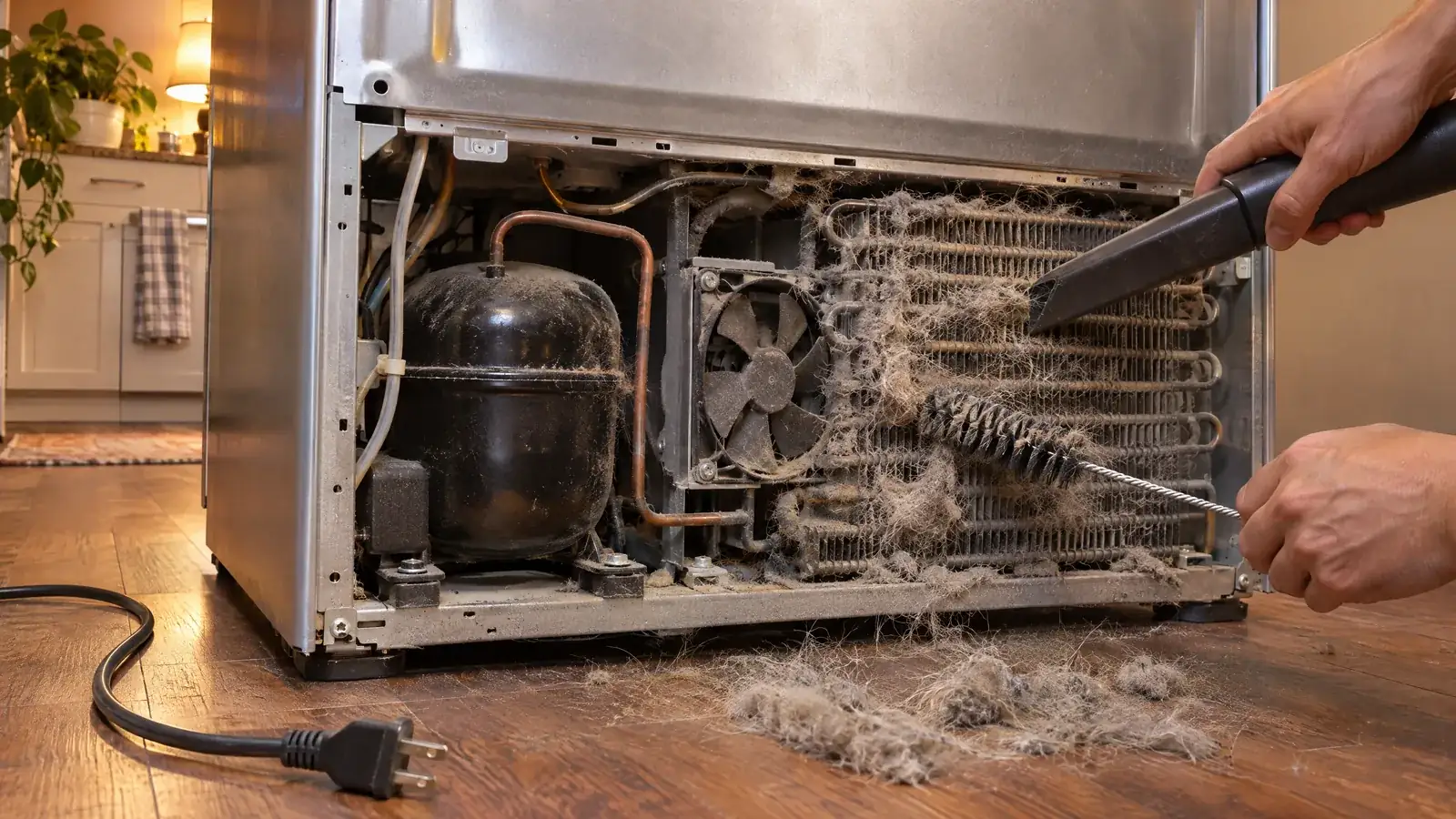
If the coils are clean, the fan runs, the seals hold and both compartments still won’t get cold, the problem is in the starting parts, the controls or the sealed system. That’s where a technician’s diagnosis saves you money: book a refrigerator repair online and you get the price before any work starts.
Start relay or compressor: what’s the difference?
The start relay is a small plug-on part that gives the compressor its starting boost, and some models also use a start capacitor. When the relay fails, the compressor clicks and won’t start, even though the compressor itself may be healthy. Replacing a relay is quick. Replacing a compressor means recovering the refrigerant, brazing in the new compressor and a new filter-drier, pulling a vacuum and recharging the system.
Compressor repair cost and whether it’s worth it
A refrigerator compressor replacement costs about $500 to $1,250, depending on the source, the size of the fridge and whether other sealed-system parts have failed too. That’s why the repair only makes sense on a newer or higher-end refrigerator. Our refrigerator repair cost guide puts the compressor next to every other common part, from fan motors to ice makers.
| Repair | Typical cost | Source |
|---|---|---|
| Compressor replacement (part, labor, recharge) | $700 to $1,250 | HomeGuide |
| Compressor part only | $200 to $400 | HomeGuide |
| Compressor repair or replacement | $500 to $1,000 | Fixr |
| Full sealed-system repair | $800 to $1,200 | Fixr |
| Condenser coil cleaning | $60 to $100 | Fixr |
Sources: HomeGuide refrigerator compressor cost; Fixr refrigerator repair cost (updated August 29, 2025). Prices vary by brand and model. HomeGuide puts labor at $500 to $850 and the job at 3 to 8 hours.
Worked example: repair or replace?
- HomeGuide says a compressor is worth replacing if it’s still under warranty, the fridge is less than 5 years old, or a new fridge would cost twice as much as the repair. It notes many manufacturers warranty the compressor for 5 to 10 years, so check yours: the part may be free even if the labor isn’t.
- A 4-year-old French-door fridge with a $1,000 compressor quote and a compressor warranty: repair it.
- A 13-year-old top-freezer fridge with the same quote: HomeGuide puts a new fridge at $600 to $2,300, and the old one may cost about $95 a year more to run once it passes 15. Replacing it is usually the better buy.
- High-end built-ins such as Sub-Zero cost far more to replace, so a sealed-system repair often makes sense on them even when they’re older. For other appliances, see our appliance repair cost guide and how long appliances last.
Florida and South Carolina: heat, surges and outages
A fridge in a hot garage or a kitchen that gets warm during summer afternoons makes the compressor run longer, so clean coils and open airflow matter more here. Storm season adds power problems. Ready.gov warns that power may return with momentary surges or spikes that can cause damage, and advises disconnecting appliances during an outage. Unplugging the fridge until power is stable protects the compressor’s starting parts and the control board.
If the compressor stops for good, keep the doors shut. Ready.gov says a refrigerator keeps food cold for about four hours and a full freezer holds its temperature for about 48 hours. Move medicines and the most perishable food to a cooler with ice if the repair can’t happen that day.
When to call a technician
Call when the coils are clean and the fan runs but both compartments stay warm, when the compressor clicks and won’t start, when the breaker trips, or when you smell burning. Caspi Home Service repairs side-by-side, French door, top-freezer, bottom-freezer and built-in refrigerators of all major brands, including Whirlpool and Samsung. The technician finds out whether it’s the relay, a fan, the controls or the compressor, gives you an upfront price before any work, and uses OEM parts. Repairs come with a 90-day parts-and-labor warranty.
Frequently asked questions
How do you know if your refrigerator compressor is bad?
Both the fridge and the freezer warm up, and the compressor either clicks without starting, hums loudly without cooling, runs nonstop, or gets too hot to touch. Before deciding it’s the compressor, clean the condenser coils, confirm the condenser fan runs and check the door seals. A technician confirms it by testing the start parts and the compressor windings.
Why is my refrigerator compressor clicking on and off?
One click as the compressor starts or stops is normal. Clicking every few minutes, with the compressor never running and the fridge warming up, usually means the overload protector is cutting off a compressor that can’t start. A failed start relay is a common cause and a much cheaper fix than the compressor.
Can a refrigerator compressor be fixed, or does it have to be replaced?
The compressor itself is a sealed unit, so it’s replaced, not rebuilt. The parts around it, such as the start relay, capacitor, overload and condenser fan, can be replaced on their own, and they cause many of the symptoms people blame on the compressor.
What causes a refrigerator compressor to fail?
Mostly overwork and age: dust-packed condenser coils, a failed condenser fan, poor airflow around the fridge, and power surges that damage the starting parts. HomeGuide puts the average compressor life at 5 to 10 years, longer with regular service.
Is it worth replacing a compressor on a refrigerator?
Usually only when the fridge is newer, the compressor is still under warranty, or the fridge is a high-end built-in. HomeGuide’s guideline is a fridge under 5 years old, or a new fridge that would cost twice the repair. On an older standard fridge, the money usually goes further toward a new one.
Fridge warm and the compressor acting up?
Book a Caspi Home Service technician. Same-day and next-day appointments are available, with a free estimate when you book online and no service-call fee.
Sources
- Whirlpool Product Help: Refrigerator Normal Sounds and Noises
- Samsung: Understanding the different noises coming from your Samsung refrigerator
- HomeGuide: Refrigerator Compressor Replacement Cost
- Fixr: Refrigerator Repair Cost
- FDA: Refrigerator Thermometers, Cold Facts about Food Safety
- ENERGY STAR: Refrigerators
- EPA: Section 608 Technician Certification
- Ready.gov: Power Outages