
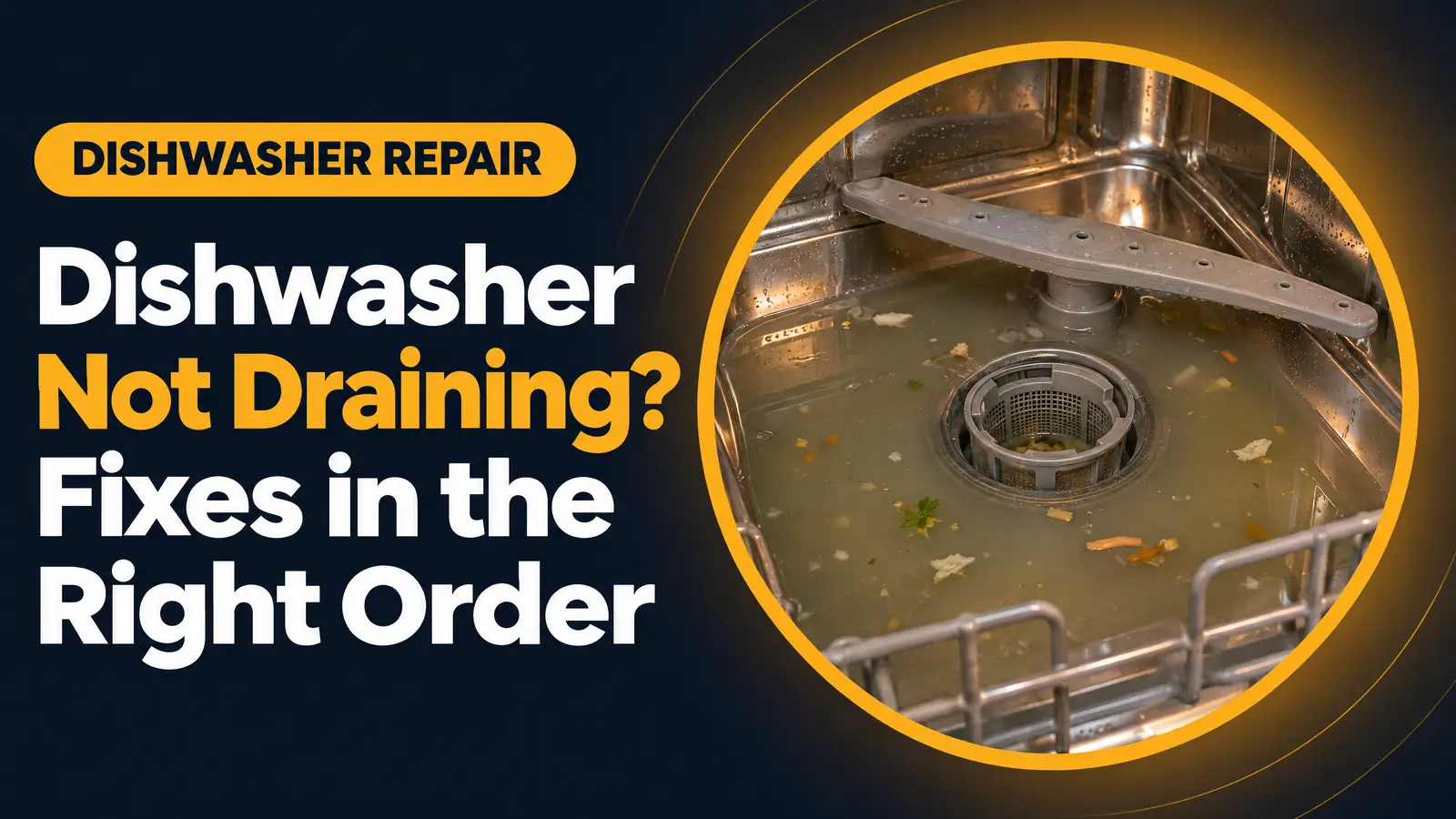
A dishwasher not draining at the end of a cycle is usually blocked somewhere between the filter and your sink drain: a packed filter, a kinked drain hose, a clogged garbage disposal or air gap, or a disposal plug that was never knocked out. A failed drain pump is less common, and it’s the one you’ll usually hear. This guide puts the checks in the order a technician uses, cheapest and safest first.
Quick answer
- A cup or two of water under the filter can be normal. Water covering the tub floor is not.
- Clean the filter and the sump first. It fixes more “won’t drain” calls than any part.
- Run the garbage disposal and the kitchen sink. If the sink backs up, it’s a plumbing clog, not the dishwasher.
- New disposal or new dishwasher? Check the knockout plug, the high loop and whether the hose is pinched under the unit.
- Humming with no water moving, or no pump sound at all, points to the drain pump or controls: book a technician.
How much standing water is normal?
Some water is supposed to stay behind. GE says that on its models without an ultra-fine filter, 1 to 2 cups of clean water covering the bottom of the tub is normal, and on models with one, water in the filter area is normal as long as it doesn’t cover the tub floor. Dirty water, food bits, a sour smell, or water up near the door opening means the drain path is blocked or the pump isn’t running.
Where the water sits tells you a lot. Whirlpool’s own guide says water just above the filter screen usually means a partial restriction in the filter, sump or hose, while water near the door opening suggests a severe blockage or a pump that isn’t running.
Safety first
- Turn the dishwasher off at the circuit breaker before you reach into the tub or under the sink. Don’t rely on the control panel alone.
- Never put your hand inside a garbage disposal. Use the disposal’s switch to run it, and tongs or pliers with the power off if something is stuck.
- Don’t pour drain cleaner into the dishwasher. GE and Whirlpool both warn against it: it can damage parts and splash back at you.
- Watch for broken glass in the sump. Wear gloves when you feel around the filter area.
Check these first (no tools)
- Restart the cycle. If the dishwasher stopped mid-cycle, cancel it and let it drain. On many Frigidaire models you press and hold Cancel for 5 to 10 seconds, then start a new cycle so it drains and resets.
- Run the kitchen sink for 30 seconds. Samsung’s test is simple: if the sink won’t drain, the problem is the home’s plumbing, not the dishwasher, and a plumber is the right call.
- Run the garbage disposal. Most built-in dishwashers drain through it. A disposal full of food stops the dishwasher too. GE recommends running the disposal before every dishwasher load.
- Look for paper or a big object over the sump. Labels from jars, a lid, bones or a wad of noodles can sit right over the drain at the back of the tub.
- Check your detergent. Regular dish soap or too much detergent makes suds, and GE notes over-sudsing can stop a dishwasher from draining properly.
Why is my dishwasher not draining? The causes, most likely first
1. A clogged filter or sump
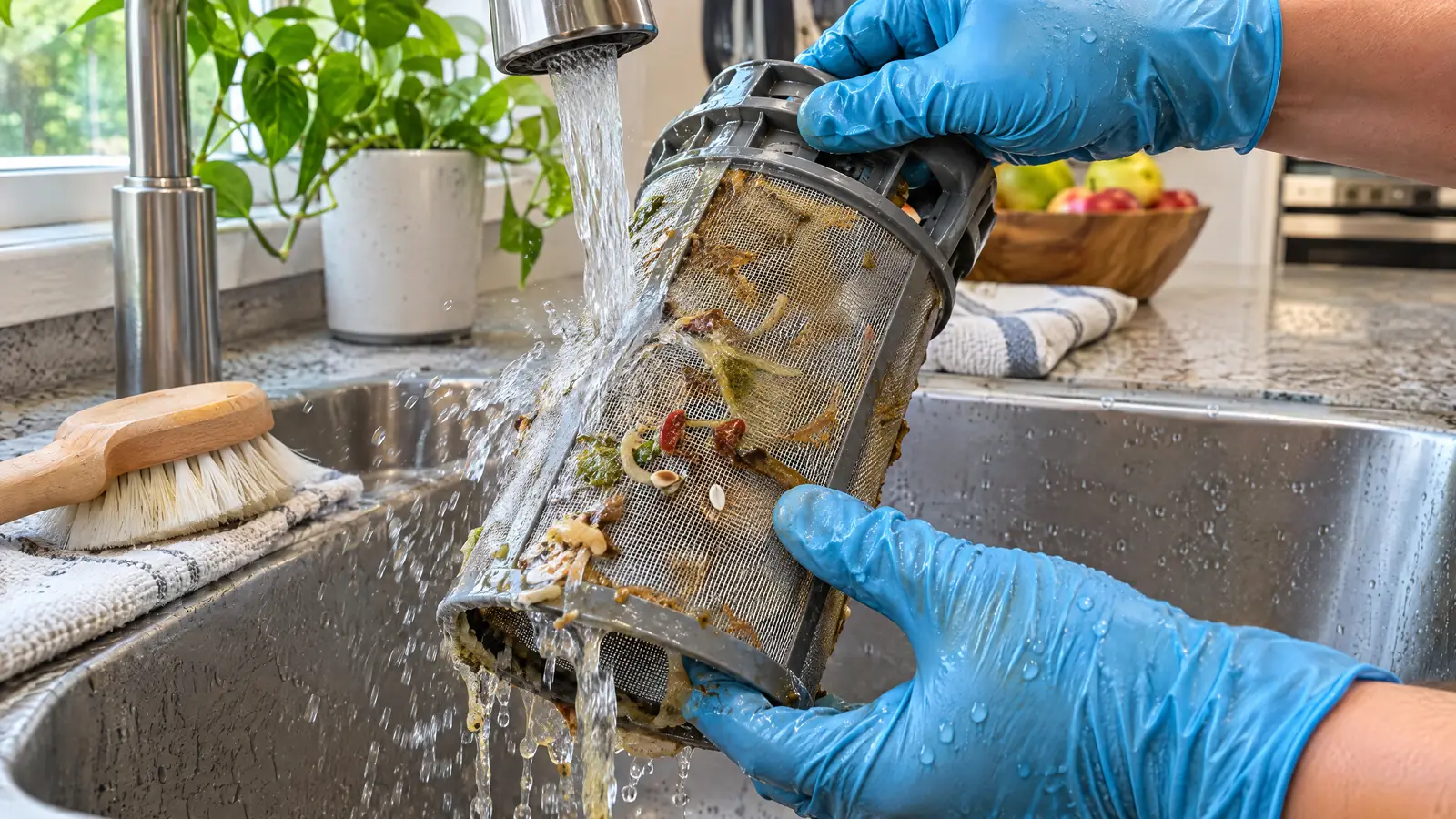
This is the usual answer. Most newer dishwashers have a manual filter you’re meant to clean, often a twist-out upper filter over a lower mesh. When it’s packed with grease, seeds and labels, water drains so slowly the cycle ends with a puddle.
How to tell: water sits just above the filter, and it’s cloudy with bits of food. Fix: with the breaker off, bail out the water with a cup and a turkey baster, take the filter out (Whirlpool: twist the upper filter counterclockwise and lift it), rinse it under warm water with a soft brush, and shine a flashlight into the sump for glass, toothpicks or labels. Seat it back fully. A filter that isn’t locked in can let debris into the pump.
2. A kinked, crushed or sagging drain hose
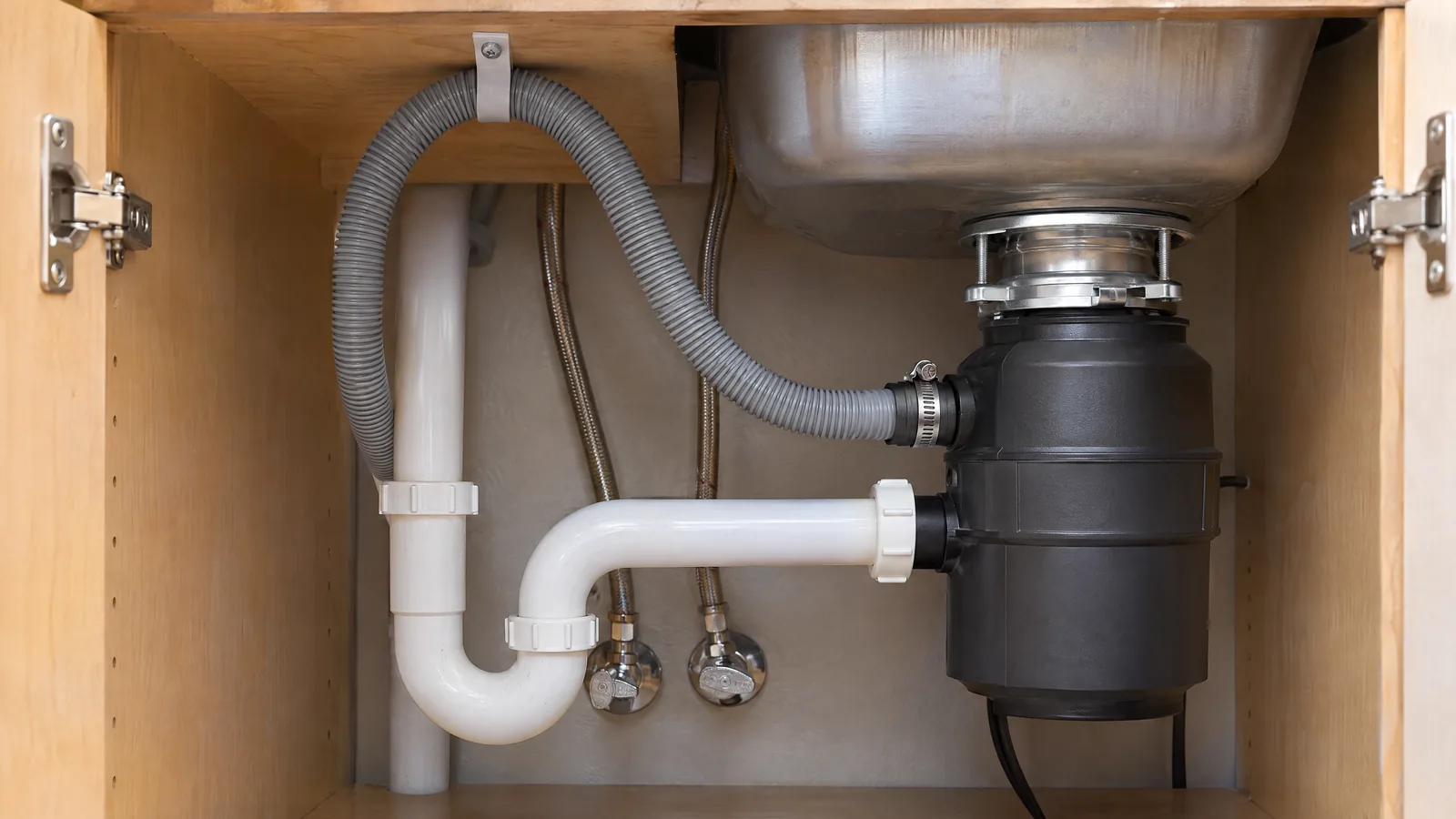
The drain hose runs from the pump, under the dishwasher, to the sink drain or disposal. Samsung says the most common drain problem right after installation is the dishwasher sitting on its own drain hose and pinching it shut. A hose that got bumped while someone stored cleaning supplies under the sink can kink too.
How to tell: the problem started after an install, a move or a cabinet clean-out. Fix: straighten what you can reach under the sink. If the kink is behind or under the dishwasher, the unit has to be pulled out, and that’s a technician or installer job because water and electrical lines come with it.
3. A missing high loop or a clogged air gap
Your dishwasher needs one of two things to stop dirty sink water flowing back into it: an air gap (the small chrome cap next to the faucet) or a high loop, where the hose rises and is fastened to the underside of the counter before dropping to the drain. GE says that without an air gap, the hose must have a high drain loop to drain correctly. Which one you need depends on your local code.
How to tell: water spits out of the air gap during the drain, or the hose under the sink droops low with no loop. Fix: pull the air gap cap off and clear the gunk inside. If there’s no loop, lift the hose and secure it under the counter at the height shown in the installation instructions.
4. The disposal knockout plug was never removed
New garbage disposals come with a plastic plug sealing the dishwasher inlet. Whirlpool calls removing it critical and says skipping it is a common misdiagnosis for a clogged dishwasher.
How to tell: the dishwasher stopped draining the day a new disposal went in, or a brand-new dishwasher never drained at all. Fix: with the disposal unplugged or its breaker off, disconnect the drain hose from the disposal inlet and look inside. If the opening is sealed with plastic, the disposal’s installation instructions show how to knock it out. Then fish the loose plug out of the disposal with pliers, never your hand.
5. A jammed or failed drain pump
The drain pump pushes water up the hose. A shard of glass, a cherry pit or a bone fragment can jam its impeller, and pumps also wear out. This is where a homeowner’s checks usually end.
How to tell: a steady hum with no water moving (jammed impeller), a grinding sound (hard debris in the pump), or total silence during the drain part of the cycle. Fix: book a technician. Testing the pump and its wiring means pulling panels and checking voltage, and that’s not a safe DIY job.
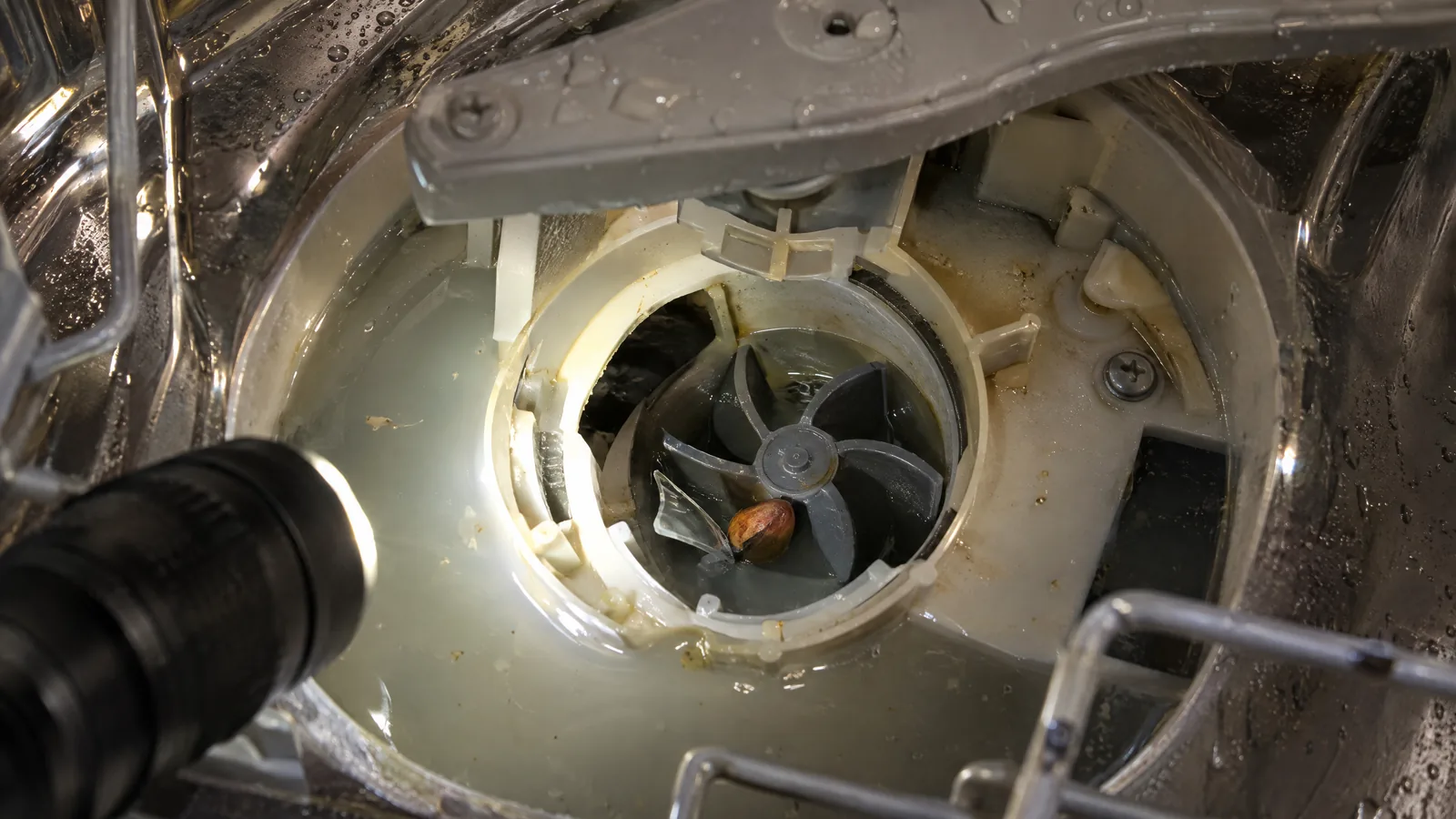
If the filter, hose, disposal and air gap are all clear and the tub still holds water, the problem is a part inside the machine. That’s the point to book a dishwasher repair online rather than keep taking things apart.
6. Control, float or door switch problems
Less often, the pump never gets told to run. Whirlpool lists a failed timer, drain solenoid on some older designs, or control board among the rarer causes, and a stuck float switch can confuse the fill and drain sequence. These need a meter and a wiring diagram, so leave them to a technician.
Symptom, likely cause and who fixes it
| What you see or hear | Likely cause | What to try | Who fixes it |
|---|---|---|---|
| Water just above the filter, food bits | Clogged filter or sump | Clean the filter and sump (breaker off) | You |
| Sink drains slowly or backs up too | Clogged sink drain or disposal | Run the disposal; test the sink for 30 seconds | You or a plumber |
| Water spits out of the faucet-side cap | Blocked air gap or hose below it | Clean the air gap cap | You, then a technician |
| Never drained since a new disposal or install | Knockout plug, pinched hose, no high loop | Check the disposal inlet and hose route | Installer or technician |
| Humming or grinding, no water moving | Jammed or failed drain pump | Stop running it | Technician |
| No pump sound at all during the drain | Pump, wiring or control fault | Reset the cycle once | Technician |
Error codes that mean “won’t drain”
Many dishwashers flag a drain problem on the display. Samsung, for example, lists 5C, 5E, OC and OE (or a set of flashing lights) as drain or overflow errors, and Frigidaire notes some models flash their indicator lights when they can’t drain. The code tells you where to look, but the checks above are the same. If the code comes back after the filter, hose and disposal are clear, it’s usually the pump or its wiring.
What does it cost to fix a dishwasher that won’t drain?
Often nothing: a clean filter or a straightened hose costs only your time. When a part has failed, these are typical national ranges with parts and labor. Prices vary by brand, model and how hard the dishwasher is to pull out, and a technician gives a firm quote after diagnosis.
| Repair | HomeGuide | Fixr |
|---|---|---|
| Replace drain pump | $100 to $400 | $150 to $400 |
| Replace drain hose | $80 to $180 | $50 to $100 |
| Install an air gap | $80 to $150 | Not listed |
| Replace float switch | $90 to $190 | Not listed |
| Control panel or board | Not listed | $200 to $500 |
Sources: HomeGuide dishwasher repair cost and Fixr dishwasher repair cost. Fixr puts the overall cost of fixing a dishwasher that doesn’t drain at $50 to $400.
Repair or replace?
- HomeGuide’s rule of thumb: fix it if the repair is under 50% of the price of a new dishwasher. It puts the cost to replace one at $600 to $1,700 and a typical lifespan at 8 to 15 years.
- Example: a 5-year-old dishwasher needing a $300 pump job is worth fixing against an $800 replacement.
- A 12-year-old unit with a rusted tub and a failed pump is usually better replaced. Our appliance repair cost guide walks through the same math for other appliances.
After a storm or power outage in Florida and South Carolina
Atlantic hurricane season runs from June 1 to November 30, and summer thunderstorms knock power out well beyond that. A dishwasher that loses power mid-cycle often sits with a tub full of wash water. That doesn’t mean it’s broken: when power is back, cancel the cycle and start a new one so it drains and resets.
If it hums but won’t drain, or the panel is dead after the outage, the problem may be electrical. Ready.gov warns that power can return with momentary surges or spikes and advises disconnecting appliances to avoid damage, so it’s worth switching the dishwasher’s breaker off during an outage. Don’t keep restarting a unit that smells hot or trips its breaker.
When to call a technician
- The filter, sump, sink, disposal and air gap are clear and water still stays in the tub.
- You hear humming, grinding or nothing at all when it should be draining.
- The drain hose is kinked or cracked behind or under the dishwasher.
- Water is leaking onto the floor as well as staying in the tub.
- The breaker trips, or you smell burning.
Caspi Home Service repairs dishwashers of all major brands, including GE, Whirlpool, Samsung and Frigidaire. There’s no service-call fee when you book, you get a clear price before work starts, and repairs carry a 90-day parts-and-labor warranty.
Frequently asked questions
Why is my dishwasher not draining after I cleaned the filter?
Check that the filter is seated and locked, because a loose filter can let debris through to the pump. Then run the disposal, test the sink, and look at the air gap and the hose under the sink. If all of that is clear and it still holds water, the drain pump is the next suspect, and that’s a technician’s job.
Why did my dishwasher stop draining after a new garbage disposal?
Almost always the knockout plug. New disposals ship with the dishwasher inlet sealed by a plastic plug. With the power off, disconnect the dishwasher hose from the disposal and look into the inlet. If it’s sealed, knock it out as the disposal’s instructions describe, then remove the loose plug from inside the disposal with pliers.
Can I use drain cleaner in my dishwasher?
No. GE and Whirlpool both say not to put drain-opening chemicals in a dishwasher. They can damage the pump, seals and hoses, and the caustic water left in the tub is a burn risk when you open the door. Bail the water out and clear the filter by hand instead.
Why is my dishwasher not draining all the way?
A partial drain usually means a partial blockage: a greasy filter, a hose that’s kinked but not closed, a slow sink drain or a dirty air gap. Some water under the filter is normal on many models. If it covers the tub floor, work through the checks in order.
How do I get standing water out of my dishwasher?
Turn the breaker off, put towels in front of the door, and bail the water into a bucket with a cup. A turkey baster gets the last of it out of the sump. Pour it down a sink or toilet. Now you can see and clean the filter.
Is it worth fixing a dishwasher that won’t drain?
Usually yes if it’s under about 8 years old, because most drain problems are a clog, a hose or a pump. Cost guides put a pump replacement at $100 to $400, well under the price of a new installed dishwasher.
Dishwasher still holding water?
Book a Caspi Home Service technician. Same-day and next-day appointments are available, with a free estimate when you book online and no service-call fee.
Sources
- GE Appliances: Dishwasher – Not Draining
- Whirlpool Product Help: Dishwasher Not Draining
- Whirlpool Product Help: Newly Installed Dishwasher Not Draining
- Samsung: Samsung dishwasher is not draining
- Frigidaire: Dishwashers – Not Draining
- HomeGuide: How Much Does Dishwasher Repair Cost?
- Fixr: Dishwasher Repair Cost
- National Hurricane Center: Tropical Cyclone Climatology
- Ready.gov: Power Outages